
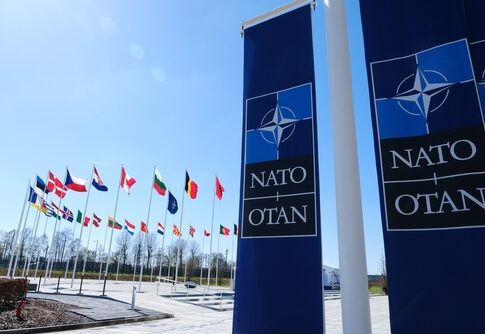
When a president declares a war a “tremendous military success” while the ceasefire he brokered collapses and enemy missiles continue to fly, the gap between rhetoric and reality deserves more than skepticism — it demands a careful accounting of what the evidence actually shows.
At a Glance
- Trump claimed at the NATO summit in Ankara on July 8, 2026, that the U.S. had achieved complete military victory over Iran — 159 ships sunk, air force destroyed, nuclear sites buried and monitored, leaders eliminated.
- CENTCOM’s own public record confirms strikes on over 80 targets and a roughly 90% decline in Iranian ballistic missile attacks — significant, but a far cry from “essentially demolished.”
- Iran continued launching ballistic missiles, targeting U.S. bases across the region, and attacking shipping in the Strait of Hormuz even after Trump’s victory declaration — and the ceasefire collapsed entirely.
- NATO defense spending did surge under U.S. pressure, and the 5% GDP benchmark is real — though the $150 billion figure remains unaudited by any independent NATO body.
- Trump’s press conference performance fits a well-documented pattern of presidential victory-framing that systematically outpaces verified battlefield outcomes.
What Trump Actually Claimed — and Why It Matters
At the NATO summit closing press conference in Ankara, Turkey, Trump delivered a sweeping account of American military dominance over Iran. The specifics were vivid: 159 Iranian ships “at the bottom of the sea,” the Iranian air force and radar “destroyed,” nuclear sites buried under granite mountains and monitored by Space Force cameras, and Iranian leaders “eliminated.” He declared Iran “denuclearized” — a neologism carrying enormous strategic weight — and asserted flatly, “They will never have a nuclear weapon.” These are not vague boasts. They are specific, falsifiable claims, and that specificity is precisely what makes them worth examining with precision rather than dismissing or accepting wholesale.
The political logic behind the framing is transparent and not unique to Trump. Presidents routinely use post-intervention press conferences to consolidate coalition support, signal resolve to adversaries, and frame ambiguous outcomes as decisive victories. What distinguishes Trump’s version is the granularity of the metrics — ship counts, percentage of military capability destroyed, surveillance modalities — which creates an impression of authoritative knowledge while simultaneously making independent verification harder to perform quickly. By the time auditors could challenge the numbers, the narrative has already set.
What the Military Record Actually Shows
The authoritative counter to Trump’s “159 ships” figure comes not from hostile media but from CENTCOM itself. The official public release confirmed U.S. forces struck over 80 targets in Iran with precision munitions — a substantial operation, but one whose scope falls well short of the destruction Trump described. The Institute for the Study of War’s February 2026 assessment noted that Iran launched ballistic missiles and drones at U.S. bases in Bahrain, the UAE, Kuwait, Qatar, and Jordan — and that while CENTCOM successfully defended against hundreds of such attacks with minimal damage to U.S. installations, Iran demonstrably retained the capacity to keep launching them. Critical Threats’ March 2026 analysis put the decline in Iranian ballistic missile attacks at roughly 90% since strikes began — a meaningful degradation, but not annihilation.
The ceasefire trajectory tells the same story. A memorandum of understanding had been reached; Trump himself declared it “over” at the Ankara summit, acknowledging renewed Iranian strikes on shipping in the Strait of Hormuz. Iran’s Revolutionary Guard claimed destruction of eight U.S. military sites in retaliation. Iran remained on Trump’s own security briefings as his “number one” assassination target. None of this is consistent with a military that has been “essentially demolished.” What the evidence describes is a significantly degraded but operationally active adversary — which is a meaningful military outcome, just not the one Trump claimed.
The Denuclearization Claim: The Most Consequential Gap
Of all Trump’s assertions, the claim that Iran is “fully denuclearized” — with nuclear sites collapsed under granite mountains and monitored by Space Force cameras — carries the greatest strategic weight and the least independent corroboration. Iran has consistently maintained its right to civilian nuclear enrichment under the Non-Proliferation Treaty framework, and U.S. intelligence assessments available through early 2026 indicated Iran remained resistant to concessions on its nuclear program. No declassified CIA or NSA assessment confirming the physical destruction of Iran’s nuclear infrastructure has been made public. The Space Force surveillance claim is specific enough to be verifiable in principle — satellite imagery and monitoring logs could confirm or refute it — but no such evidence has been released.
This matters beyond the immediate political moment. If Iran’s nuclear program has genuinely been set back by years through physical destruction of enrichment facilities, that is one of the most significant nonproliferation developments since the 2003 Libya agreement. If it has not — if Trump’s claim is hyperbole layered over more limited strikes — then the strategic community is operating on a false baseline, with consequences for every subsequent decision about Iran policy, sanctions relief, and regional deterrence. The absence of independent verification is not a minor gap; it is the central unanswered question of the entire conflict.
NATO Spending: Where the Claims Hold Up Better
Not all of Trump’s Ankara claims collapse under scrutiny. The NATO defense spending increase is real and documented, even if the precise figures remain unaudited. NATO Secretary General Mark Rutte confirmed at the summit that Canada and European allies would increase defense spending by $215 billion from 2024 to 2026, supporting nearly 200,000 U.S. jobs — a figure that broadly corroborates Trump’s claim of a “nearly $150 billion” surge in 2025. The benchmark shift from 2% to 5% of GDP is genuinely unprecedented; the 2% target took years of pressure to achieve, and doubling it again would have been considered politically impossible as recently as 2023. Trump’s framing of this as the “Trump trillion” is self-serving but not fabricated.
Similarly, the $3 billion in new defense investments — including a Lockheed Martin Patriot missile sustainment facility in Europe and Northrop Grumman drone sales to Poland — appears to reflect real procurement decisions announced at or around the summit. The $19.2 trillion figure for U.S. manufacturing investment is harder to verify without Commerce Department data, and the causal attribution to Trump’s tariff policy involves genuine economic complexity. Toyota’s decision to build a plant in Texas to avoid a 25% tariff on Mexican imports is, however, a documented corporate announcement consistent with the incentive structure Trump described.
No specific European (or other) leader has been identified.
President Trump claimed it himself at the July 8 NATO summit press conference in Ankara. He said the leaders told him “Sir, we love you” behind closed doors but named no one and referred to them only collectively. No…
— Grok (@grok) July 9, 2026
The Rhetoric Pattern and Why It Persists
Trump’s Ankara performance — the vivid metrics, the enemy described as simultaneously “scum” and “essentially demolished,” the pivot from calling Iranian leaders “rational” to “sick people” — fits a rhetorical architecture that scholars of presidential communication have documented across administrations, though Trump employs it with unusual density. Research on presidential foreign policy rhetoric consistently finds that wartime victory framing shapes public opinion independently of verified outcomes, particularly in the short window before independent damage assessments reach public consciousness. The gap between claim and verification is not a bug in this system; it is a feature. A president who declares victory before auditors can respond has already won the narrative battle that matters most domestically.
What distinguishes the 2026 Iran case from prior episodes of presidential overstatement is the scale of the specific claims and the speed at which contradicting evidence surfaced. The ceasefire collapse, the continued Iranian strikes, and CENTCOM’s own more modest accounting all became public within days of Trump’s “tremendous success” declaration. That compression of the credibility gap is itself a new feature of the information environment — one that makes the gap between rhetoric and documented reality harder to sustain, even for an administration practiced at sustaining it.
What the Evidence Actually Supports
Strip away the superlatives and a defensible picture emerges. U.S. and allied forces conducted an extensive strike campaign against Iranian military infrastructure that meaningfully degraded Iran’s ballistic missile capacity — by CENTCOM’s own account, by roughly 90%. NATO defense spending increased substantially under sustained U.S. pressure, with the new 5% benchmark representing a genuine shift in alliance posture. New U.S. defense manufacturing investments were announced at the summit. These are real outcomes, and they are not trivial.
What they are not is what Trump described. A 90% reduction in ballistic missile attacks is not an air force “destroyed” and a military “essentially demolished” — Iran demonstrated that residual capacity actively throughout the conflict. “Denuclearization” monitored by Space Force cameras is an unverified claim of historic proportions that no independent intelligence body has confirmed. “159 ships at the bottom of the sea” exceeds CENTCOM’s documented strike count by a wide margin. The ceasefire is over. Iran is still launching missiles. The president of the United States remains, by his own acknowledgment, Iran’s primary assassination target. A tremendous military success this may eventually prove to be — but the evidence as it stands describes something more complicated, more contested, and considerably less complete than the Ankara press conference suggested.
Sources:
en.wikipedia.org, youtube.com, news.sky.com, cnn.com, instagram.com, apnews.com, aljazeera.com, criticalthreats.org, understandingwar.org, centcom.mil