
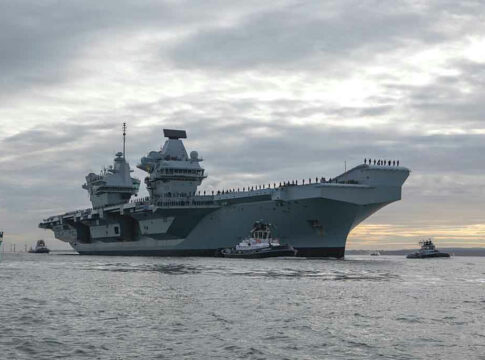
The real story behind the Navy’s “11 carriers” is not a simple headcount, but a tension between what the law demands on paper and what the fleet can genuinely put to sea.
Key Points
- Federal law hard-codes a floor of 11 operational aircraft carriers in Title 10 of the U.S. Code.
- The Navy extended the life of USS Nimitz into 2027 to avoid dipping below that legal minimum before USS John F. Kennedy is delivered.
- Critics argue Nimitz is effectively a non-deployable, end‑of‑life hull being counted to satisfy statute rather than real readiness.
- This dispute sits inside a long tradition of using extensions and legal definitions to reconcile carrier numbers with industrial limits and global demands.
What the Law Actually Requires
Carrier arithmetic in Washington starts with a statute, not a spreadsheet. Title 10 of the U.S. Code, in the section that governs naval combat forces, states that the Navy “shall include not less than 11 operational aircraft carriers.” That language is not advisory. It is a congressionally imposed floor intended to ensure the United States can maintain global presence—Pacific, Europe, Middle East—without leaving major regions uncovered when ships rotate through maintenance or training.
This legal requirement has history. Congress once set the floor at 12, then allowed it to drop to 11 when USS John F. Kennedy (CV‑67) was decommissioned, and later granted temporary waivers when the fleet briefly fell to 10. The existence of waivers underscores the statute’s force: without explicit legislative relief, the Navy is not supposed to operate below that threshold. That is why the timing of retirements and new deliveries becomes a political and legal problem, not just a logistics issue.
Why Nimitz Was Extended Instead of Retired
USS Nimitz (CVN‑68), commissioned in 1975, is the oldest nuclear carrier in U.S. service and has already exceeded the roughly 50‑year design lifespan associated with the Nimitz class. The Navy’s original plan was to retire her in May 2026 after more than five decades at sea. Construction delays on Ford‑class follow-ons, particularly USS John F. Kennedy (CVN‑79), disrupted that plan. Congressional Research Service timelines and Navy reporting place Kennedy’s delivery into 2027, not 2026.
Faced with a looming gap—Nimitz gone, Kennedy not yet delivered—the Navy did something it has done before: it extended a carrier’s service life. In March 2026, Navy officials confirmed that Nimitz’s inactivation would be pushed to March 2027, explicitly “in line with carrier John F. Kennedy’s delivery,” so the fleet would not drop below 11. USNI News and other outlets describe this as a deliberate alignment of decommissioning and new hull delivery, a classic force-structure maneuver designed around a statutory minimum rather than a tactical desire to keep a venerable ship at sea.
The extension is not merely an accounting trick on paper. It triggers real-world steps: Nimitz begins a final deployment, then a transit toward her ultimate decommissioning site, including a homeport shift to Norfolk, Virginia. Those movements are part of the inactivation and defueling pipeline, but they keep the ship in commission and available for at least limited operations until the date Congress and the Navy have effectively synchronized.
Counting “Operational” Carriers Versus Deployable Carriers
The word that drives this entire debate is “operational.” In statutory language it appears as a modifier to the carriers Congress requires. In public discourse it is often assumed to mean “ready to deploy at full combat capability.” The Navy’s internal usage is more nuanced: a carrier can be in commission and part of the operational inventory even while in deep maintenance, training, or transit.
In practice, the United States almost never has 11 carriers ready to fight. Analyses of carrier cycles describe a “rule of thirds”: at any given time roughly a third of the carrier force is deployed, a third is in work-ups and transit, and a third is in maintenance or overhaul. That pattern, reflected in historic Proceedings discussions from the early 1980s, shows 12 carriers in commission but only about four deployed, with the others cycling through training or extended yard periods. The structure is deliberate; the law’s floor of 11 is set to make sure that, even with this rhythm, the Navy can still surge four to six carriers when global crises demand it.
From that perspective, Nimitz’s status through early 2027 matters less than whether she is legally in commission and available for some level of service, and more than whether the overall inventory stays at 11 until Kennedy can join. The statute does not distinguish between a carrier on station in the South China Sea and one completing its final transit toward defueling; it simply demands that both be part of a roster that never falls below the mandated minimum.
The Counter-Argument: A Carrier That “Will Never Deploy Again”
Critics challenge this logic by focusing on the real-world condition of Nimitz herself. Commentary and video analysis highlight that her reactors are burning fuel loaded more than 25 years ago and are “nearly depleted,” framing the ship as a platform approaching the limits of its nuclear endurance. National Interest and other outlets argue that, in practical terms, the ship will likely remain close to port and will “probably remain in port” until decommissioning, making her status more symbolic than operational.
One widely circulated breakdown claims that of the 11 carriers the government lists, five “cannot move, cannot launch, and cannot fight,” and that Nimitz’s decommissioning date has been pushed back even though “she will never deploy again.” The thrust of that criticism is clear: if a carrier is effectively a museum piece in its final year, counting it toward a legal floor is a fiction about readiness, not a description of usable combat power.
There is a kernel of truth here. The Navy does not publicly release detailed operational certification documents for individual carriers, and nothing in the available record definitively shows Nimitz cleared for full-spectrum deployment across the extension period. The absence of those records fuels speculation that the extension is primarily about legal compliance. At the same time, critics generally do not grapple with the statutory language or with the Navy’s explicit, on‑the‑record rationale that the extension was aligned with Kennedy’s delayed delivery to keep the number of carriers above 10.
History: Extensions and Counting Practices Are Not New
To understand why this dispute is more structural than scandalous, you have to look backward. The U.S. has been managing carrier numbers through extensions, conversions, and phased retirements for decades. During the Cold War, conventionally powered carriers underwent Service Life Extension Programs (SLEP) that pulled them out of normal rotations for years while they were modernized, yet they remained “in commission” for counting purposes.
Naval historians note that carrier inventories have long blurred the line between truly deployable ships and those that are technically counted but operationally constrained. In World War II, Langley—America’s first carrier—had been converted into a seaplane tender; it no longer fit the functional profile of a fleet carrier but sat inside debates about how many “carriers” the Navy had. More broadly, the evolution of carriers includes many hulls converted from other types or relegated to training and experimental roles, yet still present in the inventory tally.
Seen through this lens, the Nimitz extension is not a novel legal loophole. It is a contemporary instance of a pattern in which Congress sets a number, the Navy manages a complex fleet through maintenance and modernization cycles, and the public argument oscillates between legal status and combat readiness. The difference now is that social media and video commentary accelerate and amplify skepticism in a way that Proceedings articles and specialist debates once kept mostly inside professional circles.
Industrial Base, China, and Why the Number 11 Feels Tight
The reason this argument feels more urgent today is that the margin between statutory minimum and strategic demand has narrowed. Analysts describe the United States as an “11‑carrier navy in a 15‑carrier world,” meaning the fleet is sized for a level of global obligation that increasingly strains sailors and hardware. China is projected to field up to nine carriers by the mid‑2030s, expanding its ability to contest sea control in the Western Pacific and beyond.
At the same time, the U.S. industrial base for nuclear-powered carriers is concentrated in a single yard, Newport News Shipbuilding. That yard must juggle new construction and the massive Refueling and Complex Overhaul (RCOH) process, which can consume a carrier for roughly 2,100 days—nearly six years—taking it off the deployment board while still keeping it in the “operational” count. Supply-chain constraints, specialized labor requirements, and budget pressure make it difficult to accelerate schedules when delays occur. When a ship like Kennedy slips, there is no second yard waiting to pick up the slack.
From Congress’s perspective, the floor of 11 is meant to hold the line against those pressures. From the Navy’s perspective, extending Nimitz is a pragmatic response to a bottleneck: keep the old ship counted long enough for the new ship to arrive, then retire the legacy hull. From critics’ perspective, it exposes the fragility of a system that can be knocked off balance by a single delayed delivery and must rely on near‑end‑of‑life platforms to remain legally compliant.
Where the Real Problem Lies: Law, Readiness, and Transparency
So is the Navy “counting a ship that may never sail again” to obey the law? In a narrow legal sense, yes: Nimitz’s extension is explicitly tied to maintaining the statutory minimum until Kennedy joins the fleet, and the ship’s age and reactor status make it unlikely she will be used for heavy deployments in that final year. That is not a secret; it is the logic of the decision.
The deeper issue is not that the Navy is cheating the law, but that the law itself measures inventory, not readiness. A carrier undergoing RCOH or completing its last transit to the breakers is counted the same as one surging into a crisis zone. The statute was designed that way because Congress cannot realistically micromanage readiness cycles. Yet that design means the public hears “11 operational carriers” and reasonably imagines 11 fight‑ready ships, when the planners know that, on a good day, half that number can be put to sea quickly.
For a 40‑plus reader watching this unfold, the takeaway is not that carrier numbers are fake. It is that numbers in law and numbers in practice answer different questions. The law’s 11 speaks to minimum structural capacity. The critics’ six speaks to immediate fight‑tonight readiness. Both are valid metrics; both leave something out. What will matter over the next decade—especially as China’s fleet grows and U.S. budgets tighten—is whether Congress, the Navy, and the public can talk honestly about that gap without mistaking necessary legal maneuvering, like the Nimitz extension, for bad faith.
Sources:
19fortyfive.com, facebook.com, breakingdefense.com, stripes.com, reddit.com, nationalinterest.org, news.usni.org, navaltoday.com, en.wikipedia.org, navy.mil, instagram.com, govinfo.gov, jstor.org